Sharing community news in effort to celebrate our wealthy community and its progress.
Thursday, June 21, 2012
CCHS displaying variety of exhibits at Connell House
The Carleton County Historical Society (CCHS) is displaying a wide array of exhibits at the historic Hon. Charles Connell House in Woodstock this summer.
The first one is a display commemorating the bicentennial of the War of 1812, fought between Britain and the United States. The soldiers were collected by Col. Edward Raban Vince and donated to CCHS by Col. Vince's family.
There are nearly 1,000 toy soldiers on display at Connell House from regiments such as, but not limited to, the 9th Queen's Royal Lancers, Mountain Artillery, Royal Artillery, 1st Dragoons and Somersetshire Light Infantry, and the 7th Bengal Infantry. The soldiers were manufactured in England in the early 1900s.
The second exhibit is a musical instrument display. A variety of instruments from years gone by are being shown.
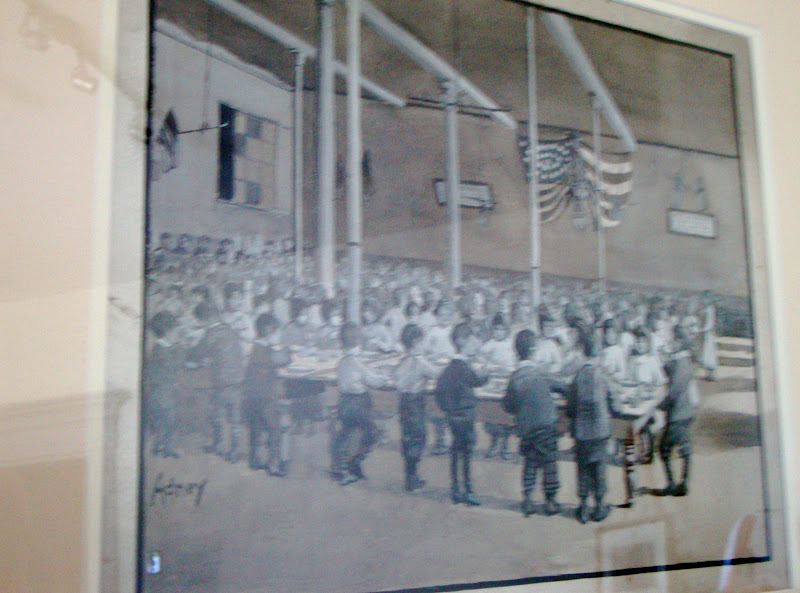
Another interesting item being revealed to the public this summer is on Connell House's second floor, in a room full of items relating to the notable Edwin Tappan Adney.
Below is a painting by Tappan Adney that has been loaned to the CCHS by Tappan Adney's granddaughter.
Another exhibit commemorating the War of 1812 bicentennial will be available for the public to view at Connell House in August. This exhibit will highlight New Brunswick's perspective on the conflict and will feature five banners in both of the province's official languages (English and French). Maps, portraits, photos of artifacts, and replica uniforms are also among the items being displayed in the travelling exhibit. The exhibit was unveiled in March 2012 at the City Hall Gallery in Fredericton. Other stops include the Fredericton Public Library and Queens County Museum.
The cost to view the exhibits in Woodstock is $5.00 per person. For more information, contact CCHS's executive director, Kellie Blue-McQuade, by calling (506) 328-9706 or via email (cchs@nb.aibn.com).
The first one is a display commemorating the bicentennial of the War of 1812, fought between Britain and the United States. The soldiers were collected by Col. Edward Raban Vince and donated to CCHS by Col. Vince's family.
There are nearly 1,000 toy soldiers on display at Connell House from regiments such as, but not limited to, the 9th Queen's Royal Lancers, Mountain Artillery, Royal Artillery, 1st Dragoons and Somersetshire Light Infantry, and the 7th Bengal Infantry. The soldiers were manufactured in England in the early 1900s.
The second exhibit is a musical instrument display. A variety of instruments from years gone by are being shown.
Another interesting item being revealed to the public this summer is on Connell House's second floor, in a room full of items relating to the notable Edwin Tappan Adney.
Below is a painting by Tappan Adney that has been loaned to the CCHS by Tappan Adney's granddaughter.
Another exhibit commemorating the War of 1812 bicentennial will be available for the public to view at Connell House in August. This exhibit will highlight New Brunswick's perspective on the conflict and will feature five banners in both of the province's official languages (English and French). Maps, portraits, photos of artifacts, and replica uniforms are also among the items being displayed in the travelling exhibit. The exhibit was unveiled in March 2012 at the City Hall Gallery in Fredericton. Other stops include the Fredericton Public Library and Queens County Museum.
The cost to view the exhibits in Woodstock is $5.00 per person. For more information, contact CCHS's executive director, Kellie Blue-McQuade, by calling (506) 328-9706 or via email (cchs@nb.aibn.com).
Monday, June 18, 2012
Traffic Advisory: Route 550 - Woodstock
The New Brunswick Department of Transportation wishes to advise motorists in Woodstock and the surrounding areas of a detour on Route 550 in Hartford.
A 700-metre section of Route 550 will be closed to traffic for two weeks, beginning on Monday, June 18th and ending on Sunday, July 1st.
This section winds through the woods over a rough S-curve. The DoT will work over the next two weeks to remove the S-curve and replace a large concrete pipe.
Traffic will be detoured to Lockhart Mill Road. Traffic control equipment will also be used.
A 700-metre section of Route 550 will be closed to traffic for two weeks, beginning on Monday, June 18th and ending on Sunday, July 1st.
This section winds through the woods over a rough S-curve. The DoT will work over the next two weeks to remove the S-curve and replace a large concrete pipe.
Traffic will be detoured to Lockhart Mill Road. Traffic control equipment will also be used.
| Barricade on Route 550 in Hartford just past Kojax Convenience |
Thursday, June 14, 2012
Vacant property in southern Woodstock still awaits development
| This vacant lot along Houlton Street in Woodstock, which has sat vacant since late in 2005, is still awaiting development. |
The lot on Houlton Street where Sunset Building Supplies used to stand, more commonly known as the "old Save Easy," in reference to the Atlantic Save Easy which operated at the location prior to the opening of the Atlantic Super Store at the turn of the 21st century, has remained dormant since 2005, when the old Save Easy was destroyed by fire. The structure had stood empty for several years prior to the blaze.
In the summer of 2011, a developer announced plans to construct townhouses targeted towards seniors on the property. A billboard was placed on the lot to attract interest in the complex.
The contact number has been removed from the billboard, sparking curiosity in terms of the future of the development.
Woodstock Mayor Art Slipp was recently contacted by The Shiretown Blogger to inquire about the development. Though the contact number has been removed, looks can be deceiving. Slipp said the exact commencement date of the project is unclear, but it will go ahead at some point.
"Although there is no start date, this project is still an "active" file," Slipp told The Shiretown Blogger via email. "We all hope it will become a reality soon."
Procrastination at the end of the school year/beginning of summer
I still have difficulty coming to terms with the fact that this school year has come to an end. An end that seems abrupt in a sense. It seems like just yesterday that I began my junior (grade eleven) year at Woodstock High School.
As the year draws to a close, things tend to get busier for students and teachers alike. Students end up with more social and personal events on their plate, and teachers have an increased amount of marking to do.
This increase in teachers' workloads is often due to the big, long, P word that we cringe upon hearing.
That word, my friends, is procrastination.
My handy Oxford Colour Dictionary (yes, I still use one of those) defines the verb procrastinate as "to delay or postpone action." We often associate it with the poor habit of leaving things to the last possible minute.
As far as I know, none of us have a collection of medals for perfection, so we are all guilty of procrastinating at some point in our lives. However, developing a habit of putting everything off as long as possible tends to make a person look sloppy and disorganized.
I began this segment of The Blogger Speaks by discussing how busy we tend to be as the school year winds down. For anyone who is part of a high school graduating class, many important senior activities occur as your final year of high school is waning. Within the past month at WHS, a senior banquet has been held, along with various other activities directed towards the senior class.
Within the past two weeks, an awards banquet has been held at the WHS gymnasium. It was with true honor that I was in attendance. Many students of all grades at WHS were recognized for their academic achievements, athletic participation and dedication to WHS activities.
Within the next week, the baccaleurate service, prom, the (infamous) prom party and the graduation ceremony will take place. For high school seniors, your life will flash upon your eyes as you come to terms with the fact that you have completed twelve years of education and are now adjusting to life in the big world.
As I recently discovered, the last few weeks of classes bring what seems like more final projects and assignments than the rest of the school year (both semesters combined). I noticed a seemingly large increase in the workload in one class in particular, Environmental Science.
A lot of students would complain to the teacher about how there appeared to be more work to do at the end of the course, primarily the small independent project component of the course which we were expected to chip away at throughout the second semester. The teacher would respond by saying, "There's more work because you've left it to the last minute."
I worked away at finishing the work to which I was assigned in Environmental Science for the last week of classes, then chipped away at home at (overdue) projects and assignments for Canadian History class, not to mention that I worked towards finishing the independent project component of the Environmental Science course.
This is the point where I go against everything I have said up to this point in this commentary.
The main reason I can think of as to why the Canadian History work was late was due to the work I was scrambling (you guessed it, at the last minute) to finish for Environmental Science.
So I'll admit it, Mr. McLaughlin, I left the independent component of Environmental Science to the end. But the independent projects I managed to complete (I had planned on attempting more) exceeded the requirement prior to the projects being graded.
I was also lucky with the overdue Canadian History stuff, however. My teacher was willing to accept the project and assignment. He easily could have deducted marks, or even given me a zero.
The point I am trying to drive home is that I was fortunate enough to get by this time by procrastinating. However, procrastination in schoolwork is often evident, therefore, a teacher will be able to determine if you put your best foot forward or crammed the night before.
I will admit, sometimes it is necessary. But it is something we should take caution to avoid when possible.
As the year draws to a close, things tend to get busier for students and teachers alike. Students end up with more social and personal events on their plate, and teachers have an increased amount of marking to do.
This increase in teachers' workloads is often due to the big, long, P word that we cringe upon hearing.
That word, my friends, is procrastination.
My handy Oxford Colour Dictionary (yes, I still use one of those) defines the verb procrastinate as "to delay or postpone action." We often associate it with the poor habit of leaving things to the last possible minute.
As far as I know, none of us have a collection of medals for perfection, so we are all guilty of procrastinating at some point in our lives. However, developing a habit of putting everything off as long as possible tends to make a person look sloppy and disorganized.
I began this segment of The Blogger Speaks by discussing how busy we tend to be as the school year winds down. For anyone who is part of a high school graduating class, many important senior activities occur as your final year of high school is waning. Within the past month at WHS, a senior banquet has been held, along with various other activities directed towards the senior class.
Within the past two weeks, an awards banquet has been held at the WHS gymnasium. It was with true honor that I was in attendance. Many students of all grades at WHS were recognized for their academic achievements, athletic participation and dedication to WHS activities.
Within the next week, the baccaleurate service, prom, the (infamous) prom party and the graduation ceremony will take place. For high school seniors, your life will flash upon your eyes as you come to terms with the fact that you have completed twelve years of education and are now adjusting to life in the big world.
As I recently discovered, the last few weeks of classes bring what seems like more final projects and assignments than the rest of the school year (both semesters combined). I noticed a seemingly large increase in the workload in one class in particular, Environmental Science.
A lot of students would complain to the teacher about how there appeared to be more work to do at the end of the course, primarily the small independent project component of the course which we were expected to chip away at throughout the second semester. The teacher would respond by saying, "There's more work because you've left it to the last minute."
I worked away at finishing the work to which I was assigned in Environmental Science for the last week of classes, then chipped away at home at (overdue) projects and assignments for Canadian History class, not to mention that I worked towards finishing the independent project component of the Environmental Science course.
This is the point where I go against everything I have said up to this point in this commentary.
The main reason I can think of as to why the Canadian History work was late was due to the work I was scrambling (you guessed it, at the last minute) to finish for Environmental Science.
So I'll admit it, Mr. McLaughlin, I left the independent component of Environmental Science to the end. But the independent projects I managed to complete (I had planned on attempting more) exceeded the requirement prior to the projects being graded.
I was also lucky with the overdue Canadian History stuff, however. My teacher was willing to accept the project and assignment. He easily could have deducted marks, or even given me a zero.
The point I am trying to drive home is that I was fortunate enough to get by this time by procrastinating. However, procrastination in schoolwork is often evident, therefore, a teacher will be able to determine if you put your best foot forward or crammed the night before.
I will admit, sometimes it is necessary. But it is something we should take caution to avoid when possible.
Tuesday, June 12, 2012
Guitard to visit Connell House tonight
Nicholas Guitard will do a presentation for the Carleton County Historical Society at Connell House, located at 128 Connell Street in Woodstock, on June 12th (tonight) at 7 pm.
Quote from Nicholas Guitard:
An
exploration into the historical work of William Francis
Ganong
transformed into a journey of discovery. I quickly recognized that little is
known about Ganong and that I could awaken the conscience of New Brunswick
to his important contribution to this province and to Canada. Thus began “On
The Trail Of Ganong”.
transformed into a journey of discovery. I quickly recognized that little is
known about Ganong and that I could awaken the conscience of New Brunswick
to his important contribution to this province and to Canada. Thus began “On
The Trail Of Ganong”.
Biography of William Francis Ganong:
Born
in Carleton (now West Saint John), New Brunswick, on 19 February
1864, he
was one of seven children of James Harvey Ganong and Susan E.
Brittain.He
received his B.A. in 1884 and Masters degree in 1886 from the
University
of New Brunswick. In 1887, he received an A.B. from Harvard and later a PhD from the University of Munich in 1894. Ganong was appointed an assistant
instructor in botany at Harvard and in 1894 went to Smith College in Northampton, Massachusetts as a botany professor and eventually appointed director of their Botanical Gardens. He retired in 1932. With his death in1941, New Brunswick lost one of our finest scholars.
Ganong had a great affection for New Brunswick’s history and natural history. As a teenager, he began serious explorations of the rivers and coastal areas of the province. This investigation continued throughout his life. Summers were spent tramping through brush and over mountains researching and documenting the natural history and physiography of the province. His expeditions were epic, but unfortunately to the detriment of popular acceptance, his work was scientific and unknown to many. So strong was his drive that he pushed the limits of his energy and intellect. His character would disallow satisfaction and he would persist to revisit topics looking for minute areas to correct or append. There would always be revisiting, recalculating and insuring correctness of facts. “He was so conscientious in his work that he spared himself no trouble in order to be correct.
of New Brunswick. In 1887, he received an A.B. from Harvard and later a PhD from the University of Munich in 1894. Ganong was appointed an assistant
instructor in botany at Harvard and in 1894 went to Smith College in Northampton, Massachusetts as a botany professor and eventually appointed director of their Botanical Gardens. He retired in 1932. With his death in1941, New Brunswick lost one of our finest scholars.
Ganong had a great affection for New Brunswick’s history and natural history. As a teenager, he began serious explorations of the rivers and coastal areas of the province. This investigation continued throughout his life. Summers were spent tramping through brush and over mountains researching and documenting the natural history and physiography of the province. His expeditions were epic, but unfortunately to the detriment of popular acceptance, his work was scientific and unknown to many. So strong was his drive that he pushed the limits of his energy and intellect. His character would disallow satisfaction and he would persist to revisit topics looking for minute areas to correct or append. There would always be revisiting, recalculating and insuring correctness of facts. “He was so conscientious in his work that he spared himself no trouble in order to be correct.
Subscribe to:
Posts (Atom)